

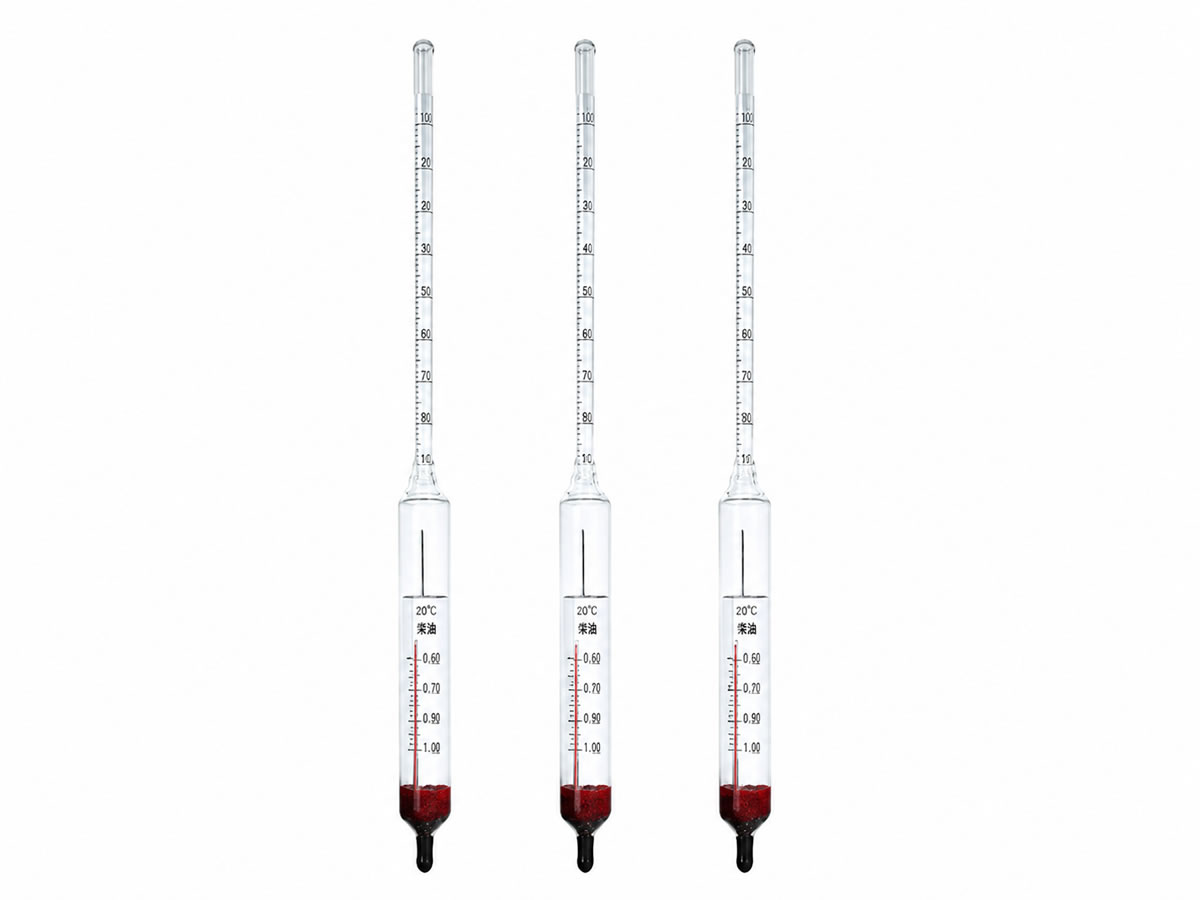
Density range / fuel type:
ANT-1 hydrometer specifications:
| Instrument type: | Glass hydrometer with built-in thermometer (ANT-1) | Glass hydrometer with built-in thermometer (ANT-1) | Glass hydrometer with built-in thermometer (ANT-1) |
| Standard: | DSTU GOST 31072:2006 (GOST 18481-81) | DSTU GOST 31072:2006 (GOST 18481-81) | DSTU GOST 31072:2006 (GOST 18481-81) |
| Density range: | 710-770 kg/m³ | 770-830 kg/m³ | 830-890 kg/m³ |
| Application: | Petrol A-80, A-92 | Petrol A-95, A-98, kerosene | Diesel fuel, light fuel oil |
| Density scale division: | 0.5 kg/m³ | 0.5 kg/m³ | 0.5 kg/m³ |
| Accuracy: | ±0.5 kg/m³ | ±0.5 kg/m³ | ±0.5 kg/m³ |
| Calibration temperature: | 20 °C | 20 °C | 20 °C |
| Built-in thermometer: | −20 to +45 °C, division 1 °C | −20 to +45 °C, division 1 °C | −20 to +45 °C, division 1 °C |
| Operating principle: | Archimedes' principle — submersion depth depends on liquid density | Archimedes' principle — submersion depth depends on liquid density | Archimedes' principle — submersion depth depends on liquid density |
| Material: | Borosilicate glass, ballast — shot with resin | Borosilicate glass, ballast — shot with resin | Borosilicate glass, ballast — shot with resin |
| Length: | ≈ 330 mm | ≈ 330 mm | ≈ 330 mm |
| Weight: | ≈ 110 g | ≈ 110 g | ≈ 110 g |
| Verification: | Passport + verification certificate (on request) | Passport + verification certificate (on request) | Passport + verification certificate (on request) |
| Warranty: | 18 months | 18 months | 18 months |
| Manufacturer: | Supplied by Gerkon LLC (Ukraine); complies with DSTU GOST 31072:2006 | Supplied by Gerkon LLC (Ukraine); complies with DSTU GOST 31072:2006 | Supplied by Gerkon LLC (Ukraine); complies with DSTU GOST 31072:2006 |
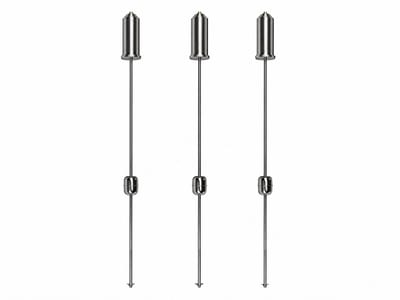
ANT-1 petroleum hydrometer by Gerkon — a precision shot-poised glass hydrometer for measuring density and specific gravity of petroleum products in accordance with the standard reference methods ASTM D1298, EN ISO 3675 and ISO 91. Used by fuel quality laboratories, refinery dispatch operations, terminal QC, fleet fuel-receipt verification and field sampling teams across Europe and CIS.
Standards and reference temperature
- ASTM D1298 — Density, Relative Density, or API Gravity of Crude Petroleum and Liquid Petroleum Products by Hydrometer Method (the dominant US/global reference)
- EN ISO 3675 — Crude petroleum and liquid petroleum products — Laboratory determination of density — Hydrometer method (the EN equivalent of D1298)
- ISO 91 — Petroleum measurement tables (volume correction factors)
- ASTM E100 — Standard Specification for ASTM Hydrometers (instrument construction)
- BS 718 — British equivalent specification (recognised in UK and Commonwealth markets)
Reference temperature for petroleum density measurement is 15 °C (EU/ISO standard) or 60 °F = 15.56 °C (US/API). ANT-1 is supplied calibrated at 15 °C; for measurements at other temperatures, apply the volume correction factor (VCF) from ASTM Table 53/54 or ISO 91.
Density range and accuracy
- Total range: 0.650–1.100 g/cm³ (covers full petroleum spectrum from light naphtha to heavy fuel oil)
- Sub-range increments: sold in narrow sub-ranges of 0.050 g/cm³ width (e.g. 0.700–0.750 for petrol; 0.800–0.850 for diesel; 0.850–0.900 for marine diesel; 0.900–0.950 for fuel oil)
- Scale graduation: 0.0005 g/cm³ (0.5 kg/m³)
- Reading accuracy: ±0.0002 g/cm³ between graduation marks
- Calibration uncertainty: ±0.0003 g/cm³ at reference temperature 15 °C
Construction
ANT-1 is a shot-poised glass hydrometer constructed from sodalime-silicate glass (linear thermal expansion 9.2 × 10⁻⁶ /K, the standard material specified by ASTM E100 for petroleum hydrometers). The bulb contains pre-weighed lead shot or steel ballast, hermetically sealed during manufacture so the instrument remains accurate indefinitely under normal use. The stem carries a printed scale visible through the meniscus during reading. Total length 320 mm, bulb diameter 32 mm, stem diameter 6 mm.
Applications
- Fuel receipt verification at terminals — confirming density of incoming tanker batches against bill of lading
- Refinery dispatch QC — finished-product density check before tanker loading
- Custody-transfer disputes — independent laboratory density measurement on sealed reference samples
- Quality control at fuel depots — periodic density check to detect adulteration (petrol diluted with diesel, etc.)
- Marine bunker QC — density determination for bunker fuel certification per ISO 8217
- Aviation fuel verification — Jet A-1 density check before refuelling (density × volume = mass for take-off calculations)
- Lubricating oil grading — base oil density classification
Procedure (summary)
- Pour the sample into a clean glass cylinder (ASTM D1298 specifies cylinder ≥ 25 mm diameter larger than bulb)
- Bring sample to reading temperature (15 °C ± 5 °C) using a water bath
- Lower the hydrometer slowly into the sample, allowing it to float freely without touching the cylinder walls
- Read the density at the bottom of the meniscus (or top for opaque samples per ASTM D1298 Section 7.4.4)
- Record sample temperature simultaneously; apply volume correction to 15 °C reference using ASTM Table 53 / ISO 91 if temperature differs
Compatibility with sample types
ANT-1 is fully compatible with all petroleum products: gasoline (petrol), diesel, jet fuel (Jet A-1, JP-8), kerosene, lubricating oils, marine fuel oils (HFO, MGO, MDO), crude oil, naphtha, AdBlue (separate water-density sub-range required). Not suitable for samples containing free water or solids — filter or separate before measurement.
Frequently asked questions
Why does ANT-1 use sodalime glass and not borosilicate?
ASTM E100 specifies sodalime-silicate glass for petroleum hydrometers because its thermal expansion coefficient (9.2 × 10⁻⁶ /K) is matched to the calibration curves in ASTM Table 53. Borosilicate (3.3 × 10⁻⁶ /K) would require different correction tables. Modern ASTM-grade hydrometers use lead-free sodalime glass for environmental compliance.
How often does ANT-1 need re-calibration?
Sealed glass hydrometers do not drift in normal use — the ballast is permanently fixed and the glass dimensions are stable. Calibration is technically lifetime under normal handling. For accredited laboratories, periodic verification (every 5 years) against a reference instrument is recommended for traceability documentation, but the actual instrument rarely requires re-adjustment.
Can I order custom sub-range hydrometers?
Yes — sub-range graduation, scale density (kg/m³ or g/cm³), reference temperature (15 °C, 20 °C or 60 °F) and total length (290/320/380 mm) are all configurable at order time. Specify your application — we suggest the optimal sub-range for typical fuel density of your product mix.
Does the supplied calibration certificate satisfy EU laboratory accreditation requirements?
Each ANT-1 ships with a works calibration certificate stating density and temperature at 15 °C reference, traceable to the Ukrainian National Metrology Institute. For ISO/IEC 17025 accredited laboratories in EU, this works certificate provides traceability for receipt verification; some accreditation bodies require an additional in-EU calibration which can be obtained from any national metrology service or accredited calibration lab.
For sub-range customisation, batch orders for laboratories or distributor enquiries — contact our export desk via the form on this page.
Frequently Asked Questions
Which hydrometer is needed for A-95 petrol?
How does ANT-1 differ from a general-purpose AON hydrometer?
Why does a fuel station need a hydrometer — is it mandatory?
How to correctly measure density step-by-step?
Does the hydrometer require periodic verification?
What is included in the delivery?
Can a single hydrometer be used for all fuel types?
SHIPPING INFORMATION FOR UKRAINE
Our company is committed to fast shipping and delivery throughout Ukraine. We work with carriers that offer the best balance of price and quality, including:
NOVA POSHTA
1-3 days. Delivery speed depends on your location. After placing your order and payment, we ship the same day or the next.
SAT
Delivery time 3-5 days. Speed depends on the distance between sender and recipient. This is the most economical option compared to Nova Poshta.
DELIVERY
Shipping takes 4-7 days. This is the slowest method, but its advantage is the low cost.
FREIGHT POOLING
Shipping is done via shared transport through a dispatcher. Finding a vehicle takes 1-2 days; speed depends on the destination (major cities are faster, remote villages slower). This method is cheaper than the carriers listed above.
We work throughout Ukraine, and on request can arrange delivery via another courier service not on our list.
After placing your order in our online store, please provide the following information for delivery to your region:
- Recipient's full name
- City or town
- Number of the nearest warehouse (if shipping via courier services)
- Mobile phone number
Once the goods are shipped, we will provide you with the waybill number. When picking up your order, please bring your passport and the waybill number.
NOTES:
- The seller is not responsible for the operation of postal / courier services.
- Shipments are insured for full value; in case of damage the carrier is obligated to compensate you in full.
- Shipping costs are paid by the buyer (or by mutual agreement).
- If the requested product cannot be supplied, an equivalent replacement will be offered upon your approval.
If you couldn't find an answer to your question in this section, please contact us for more detailed information.
PAYMENT METHODS
After placing an order for a selected product in our store, we verify stock availability and confirm with you. Payment can then be made using one of the following methods:
- Bank transfer to the company account (VAT included).
- Cash on delivery (payment upon receipt).
Before paying via bank transfer, please contact us to confirm product availability.
Cash on delivery is processed at the carrier's warehouse. The service fee is 2% of the total + 15 UAH for payment processing. For an order of 1000 UAH you will pay 35 UAH for this service plus the shipping cost.
The second method is more reliable as you can inspect the goods on the spot, but it is also more expensive, so before paying you may want to consider which method suits you best.
If payment is received by 12:00, we ship the same day; if payment arrives later, shipping is processed the next day.
For any questions about payment, please contact us — if you haven't found an answer to your question, we will provide more detailed information.
WARRANTY & SERVICE
- Warranty on Gerkon fuel dispensers — 18 months;
- Warranty on Gerkon volumetric provers — 18 months;
- Warranty on level meters — 36 months;
- Warranty on fuel dispenser connection installation — 18 months;
The manufacturer guarantees free replacement or repair of dispenser parts and assemblies that fail due to manufacturing defects, provided that transportation, storage, and operation rules are observed.